




Vintage Watches Guide Breitling
Founded in 1884 by Léon Breitling in Saint-Imier, Breitling is the Swiss manufacture that invented the modern chronograph — independent pusher (1915), two pushers (1934), slide rule (1942). From the AOPA pilots' Navitimer to James Bond's Top Time, from the Chronomat to the SuperOcean — discover our complete guide to vintage Breitling watchmaking.
Read the guide
Breitling: The Inventor of the Modern Chronograph
The story of Breitling begins in 1884, when Léon Breitling, a 24-year-old watchmaker, settled in Saint-Imier to create his first chronographs. In 1892, the company moved to La Chaux-de-Fonds and produced pocket chronographs and dashboard counters under the name "G. Léon Breitling SA Montbrillant Watch Factory". From the outset, Breitling positioned itself in a unique niche: time-measuring instruments for professionals — pilots, military personnel, engineers.
The innovations of Breitling shaped the chronograph as we know it. In 1915, Gaston Breitling (Léon's son) created the first wrist chronograph with an independent pusher — separate from the crown. In 1923, he patented the independent pusher system for starting and resetting, allowing consecutive measurements without stopping the chronograph. In 1934, Willy Breitling (Léon's grandson) patented the two-pusher chronograph — one to start/stop, one to reset. This system became the universal standard for chronographs. In 1942, Breitling launched the Chronomat — the first chronograph with a slide rule integrated into the bezel, developed with mathematician Marcel Robert. The Chronomat was adopted by the US Air Force during the Second World War.
In 1952, Willy Breitling adapted the Chronomat's slide rule for civil aviation and launched the Navitimer for members of the AOPA (Aircraft Owners and Pilots Association). In 1962, astronaut Scott Carpenter took a modified Navitimer (24-hour dial) on the Mercury Atlas 7 mission — it was the Breitling Cosmonaute, the first Swiss chronograph in space. In 1969, Breitling co-developed calibre 11 — one of the first automatic chronograph movements — with Heuer, Hamilton, and Büren. Breitling is now part of the CVC Capital Partners group (since 2017) and is associated with Universal Genève for its revival.
Vintage Breitling Collections in Detail
Navitimer: The Pilots' Chronograph
The Breitling Navitimer — a contraction of "navigation" and "timer" — is the most famous pilot's chronograph in watchmaking history. Launched in 1952 for members of the AOPA, it is distinguished by its circular slide rule on a rotating bezel with beaded balls (125 beads on the earliest references, designed to be handled while wearing flight gloves). This rule makes it possible to calculate speed, distance, fuel consumption, rate of climb/descent, and conversions between miles, kilometers, and nautical miles — an onboard computer on the wrist.
The earliest Navitimer models (1952-1954) bear no Breitling name on the dial — only the AOPA logo at 12 o’clock and "Navitimer" at the bottom. They were distributed exclusively to AOPA members. It was from 1954-1955 onward that the name Breitling appeared on the dial and that ref. 806 was marketed to the public.
Navitimer movements over time:
- Venus 178 — hand-wound, column wheel. The original movement of the first Navitimer 806 models (1952-late 1960s). The most sought-after Navitimer caliber — Venus 178 Navitimer models command the highest prices.
- Valjoux 72 — hand-wound, column wheel. Used in certain Navitimer 806 models alongside the Venus 178 (likely in response to a shortage of Venus movements). The same movement as the early Rolex Daytona and Heuer Carrera. Valjoux 72 Navitimer models are rare and sought-after.
- Valjoux 7740 — hand-wound, cam-operated (no column wheel). Replaced the Venus 178 in the late 1960s (ref. 7806). The Navitimer gained a date window but lost the column wheel. More accessible than the Venus 178 versions.
- Calibre 11 — modular automatic, developed with Heuer, Hamilton, and Büren (1969). The first automatic chronograph movement by Breitling. Left-side crown (the base Büren micro-rotor movement is reversed). Ref. 1806 "Chrono-Matic," 48 mm case ("fried egg" among collectors). Bicompax design (two sub-dials) instead of the classic tricompax.
- Valjoux 7750 — automatic, from the 1980s onward. The standard movement of modern and neo-vintage Navitimer models.
Sought-after variants: the "Twin Jet" logo (two stylized aircraft at 12 o’clock, replacing the AOPA logo on certain references), the "All Black" dial (black dial and black sub-dials — earliest references), the "Reverse Panda" dial (black dial, white sub-dials — 1960s), the "Boxed 10" marker (boxes around the "10" on the bezel, painted in orange or red, now faded). The Navitimer is the most collected and most highly valued vintage Breitling model.
Cosmonaute: The Spacefaring Navitimer
The Breitling Cosmonaute was born from astronaut Scott Carpenter's request before his Mercury Atlas 7 mission (May 24, 1962). Carpenter wanted a Navitimer with a 24-hour dial — to distinguish day from night in orbit. Breitling made him a unique piece, then put it into serial production (ref. 809). The Cosmonaute uses the same Venus 178 movement (modified for 24-hour display) and the same slide rule as the Navitimer. It is the first Swiss chronograph worn in space. Vintage Venus 178 Cosmonaute models are sought-after collectors' pieces.
Chronomat: The Renaissance of the Chronograph
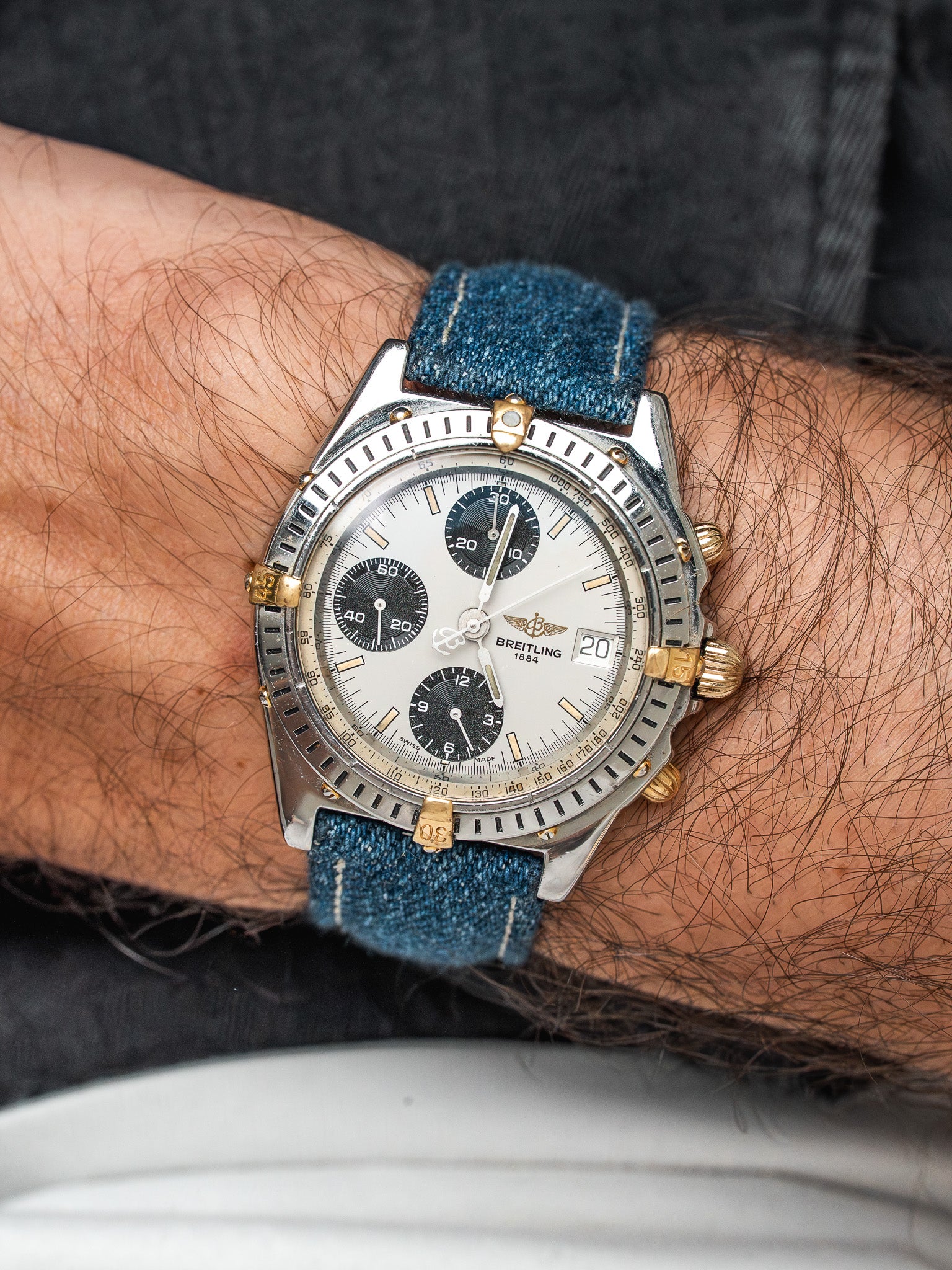
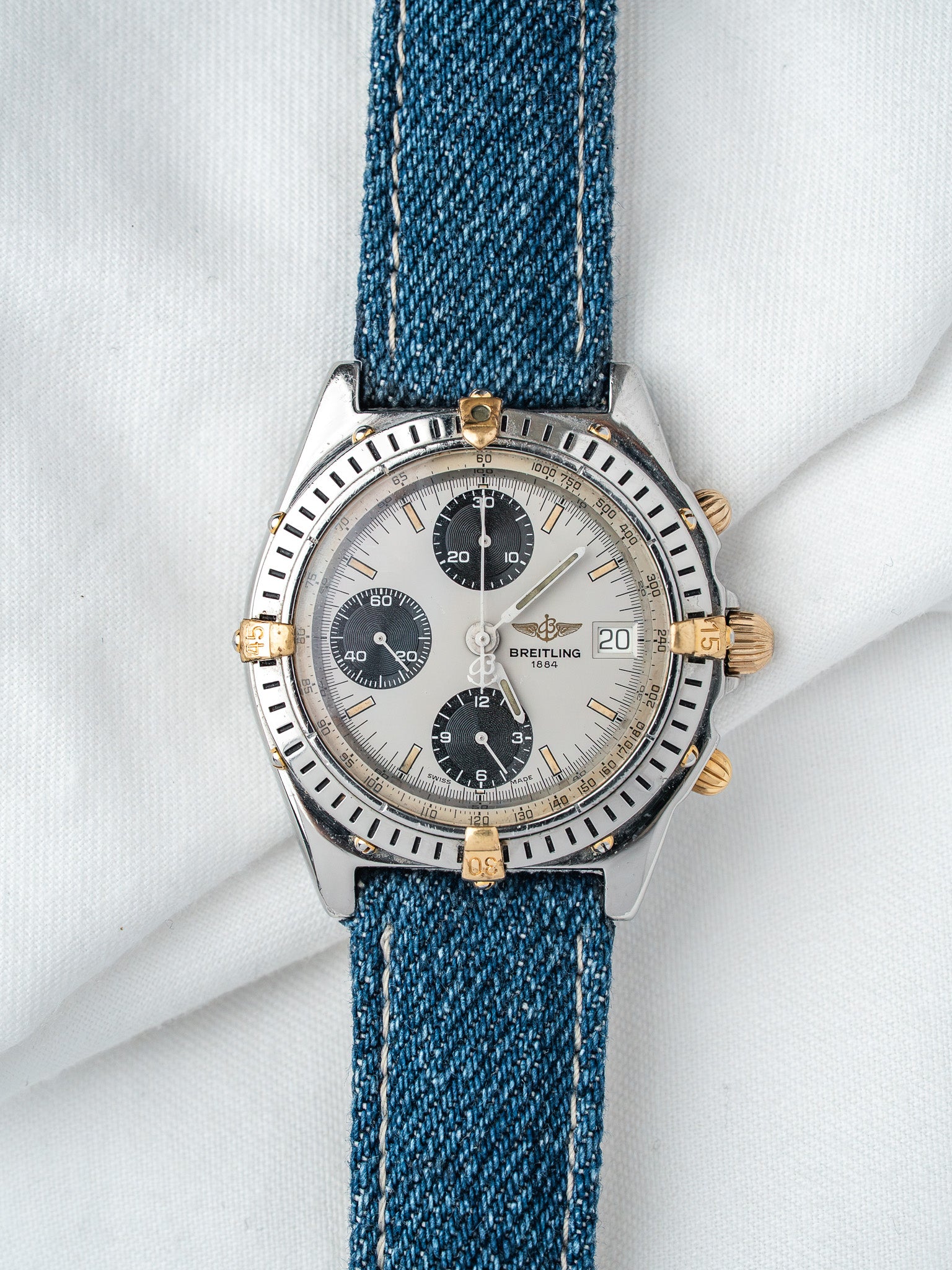
The Chronomat has two lives. The first (1942) is the original chronograph with slide rule — the predecessor to the Navitimer, equipped with the Venus 175, adopted by the US Air Force. The second (1984) is the model that revived Breitling after the quartz crisis. The 1984 Chronomat — designed in collaboration with the Patrouille de France (Italian aerobatic team Frecce Tricolori) — is distinguished by its four rider tabs bezel (raised markers at 3, 6, 9 and 12 o'clock), its 39 mm case then 41-44 mm, and its automatic movement (Valjoux 7750). The Chronomat from the 80s-90s is the most accessible and versatile vintage Breitling — a sporty-chic chronograph that works just as well with a suit as with jeans.
Top Time: The Streamlined Sports Chronograph
The Breitling Top Time, launched in the 1960s, is the most streamlined Breitling chronograph — without a slide rule, without excessive complications. "Panda" dials (white with black sub-dials) or "Reverse Panda," Venus 178 or Valjoux 7730/7733 movements, 36-38 mm cases. The Top Time was made famous by James Bond — in Thunderball (1965), Sean Connery wears a Top Time modified into a spy gadget by Q. The "Zorro" model (sub-dials linked by an 8 forming Zorro's mask) is the most sought-after variation. Vintage Top Time models are the most accessible Breitling chronographs — often between €1,500 and €3,000.
SuperOcean: The Breitling Dive Watch
The Breitling SuperOcean is Breitling's dive watch — unidirectional rotating bezel, reinforced water resistance (200 m minimum), luminous dial. Launched in the 1950s, the vintage SuperOcean is less well known than the Rolex Submariner or the Omega Seamaster 300, but offers robustness and a distinctive design. The first SuperOcean models (ref. 2005), with their triangular-marker dials and "sword" hands, are sought-after pieces. SuperOcean models from the 80s-90s (automatic ETA movement) are more accessible.
Premier & Callisto: Breitling Elegance
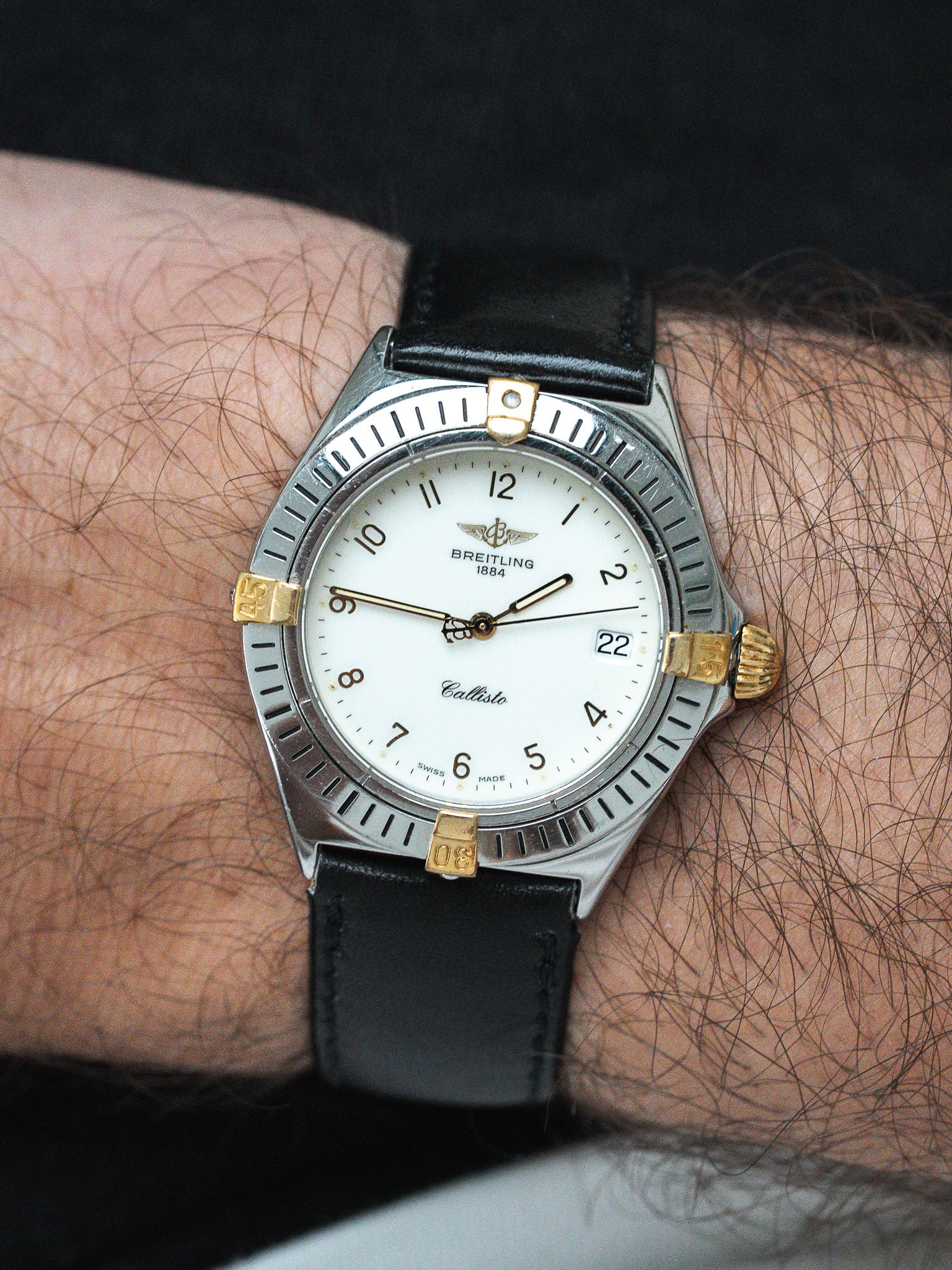
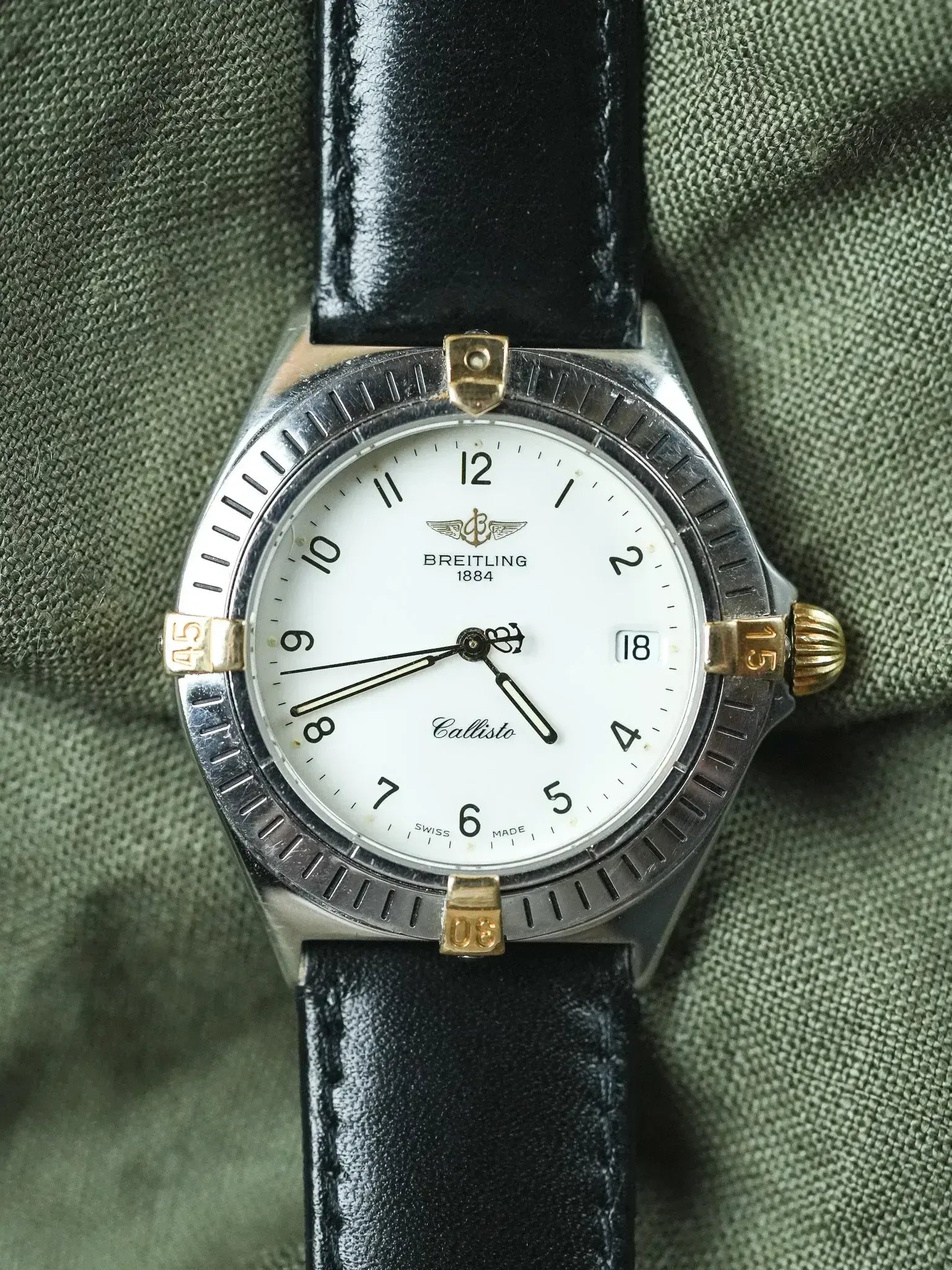
The Breitling Premier and Callisto represent the dress segment of Breitling. The Premier (reintroduced in the 1940s, relaunched in the 2000s) is a classic chronograph with a restrained dial and round case. The Callisto (1980s-90s) is a two-tone sporty-chic model (steel and gold), often in a more compact format than the Chronomat. Premier and Callisto models in 18-carat gold are the most accessible vintage dress Breitling watches.
Colt: The Military Tool
The Breitling Colt (launched in 1985) is Breitling's military collection — rotating bezel with rider tabs, luminous Arabic numerals, quartz or automatic SuperQuartz movements (thermocompensated). The vintage Colt from the 80s-90s is a robust, legible, and accessible tool watch — an entry point into the world of Breitling at a reasonable price.
The Movements of Vintage Breitling
- Venus 175 — hand-wound chronograph, the movement of the first Chronomat (1942). Cam, 17 jewels.
- Venus 178 — hand-wound chronograph, column wheel , 17 jewels. The original movement of the Navitimer and the Cosmonaute. Considered the most noble vintage Breitling calibre. Descended from the Venus 175.
- Valjoux 72 — hand-wound chronograph, column wheel. Used in certain Navitimer models and in early Rolex Daytona / Heuer Carrera watches. One of the most respected chronograph movements.
- Valjoux 7730 / 7733 — hand-wound chronograph, cam-switched. The movement used in the Top Time. Reliable, accessible, easy to service.
- Valjoux 7740 — hand-wound chronograph with date, cam-switched. Replaced the Venus 178 in the Navitimer at the end of the 1960s.
- Calibre 11 — modular automatic chronograph, co-developed with Heuer, Hamilton and Büren (1969). Büren micro-rotor base movement, Dubois Dépraz chronograph module. Crown on the left. The first automatic chronograph Breitling.
- Lémania 1873 — hand-wound chronograph, cam-switched. The same movement as the Omega calibre 861/1861 (Speedmaster Professional from 1968 onward). Used in certain vintage Navitimer and Chronomat models.
- Valjoux 7750 — automatic chronograph, cam-switched, 25 jewels. The standard movement of Breitling models from the 1980s-2000s (Chronomat, Navitimer, automatic Colt). Robust, reliable, repairable anywhere in the world.
How the Navitimer Slide Rule Works
The Navitimer slide rule is one of the most little-known — and most ingenious — functions in watchmaking. It works on the principle of logarithmic multiplication and division: two graduated scales (one fixed on the dial, one movable on the rotating bezel) make it possible to perform calculations by aligning the markings.
Practical examples: speed calculation — if you cover a known distance and time the duration, align the distance with the elapsed time and read the speed on the scale. Miles/kilometres conversion — the STAT (miles), KM and NAUT (nautical miles) markers allow instant conversions. Fuel consumption — by knowing the hourly rate and flight time, the rule calculates total consumption. On vintage Navitimer watches serviced by Atelier Victor, the bezel turns smoothly — the function is fully operational.
Breitling vs Omega Speedmaster : Two Philosophies
The Speedmaster and the Navitimer are the two most collected vintage chronographs — but they embody different philosophies. The Speedmaster is a streamlined sports watch — legible dial, simple tachymeter scale, minimalist design conceived for motor racing and later for space. The Navitimer is a complex navigation instrument — slide rule, dense dial, beaded bezel, designed for the cockpit. The Speedmaster can be read at a glance; the Navitimer requires knowledge of its functions. The two coexist in collections — they are not intended for the same use or the same temperament.
How to Recognize an Authentic Vintage Breitling
- Breitling Logo — the winged "B" (used on vintage models) or the text "Breitling" in typography specific to each period.
- AOPA / Twin Jet Logo — on Navitimer models, the logo at 12 o’clock helps date the watch: AOPA (earliest references), Twin Jet (double aircraft, 1960s+), winged "B" (1970s+).
- Reference number — engraved on the caseback. Vintage Breitling references follow a logic: 806 (Navitimer Venus 178), 7806 (Navitimer Valjoux 7740), 1806 (Navitimer Chrono-Matic calibre 11).
- Pushers — round pushers ("pump pushers") on vintage references, screw-down pushers on more recent models.
- Navitimer bezel — beaded bezel with the correct slide rule scale, smooth bidirectional rotation.
- Dial — typography consistent with the period, position and style of the subdials, coherent luminous material.
At Atelier Victor, each Breitling is opened, inspected, and authenticated by our watchmakers. Chronograph operation, subdial synchronization, bezel rotation, pusher integrity — every function is checked. Authenticity guaranteed for life.
Vintage Breitling on the Pre-Owned Market
Vintage Breitling has seen a significant renewed interest since the brand, under the leadership of Georges Kern (since 2017), reconnected with its heritage by relaunching reissues of historic models (Navitimer 806 1959 Re-Edition, Top Time, SuperOcean Heritage). The models for which demand is rising: Venus 178 Navitimer 806s (early AOPA references), "Zorro" Top Time, Venus 178 Cosmonaute models, and first-series 1984 Chronomat models. Navitimer models from the 1980s-90s with Valjoux 7750 remain the most accessible vintage Breitling models.
Frequently Asked Questions — Vintage Breitling Watches
What is the difference between Venus 178 and Valjoux 7750 on a Navitimer?
The Venus 178 is the original Navitimer movement (1952) — hand-wound, column wheel, smooth operation, the most noble and most highly regarded calibre. The Valjoux 7750 is the movement used in Navitimer models from the 1980s onward — automatic, cam, more practical for daily wear, easier to maintain. Navitimer models with Venus 178 trade at multiples of the price of versions with Valjoux 7750.
What is calibre 11 and why is the crown on the left?
The calibre 11 (1969) is Breitling's first automatic chronograph movement — co-developed with Heuer, Hamilton, and Büren. It is a modular movement: a Dubois Dépraz chronograph module is added to a Büren micro-rotor base movement. The base movement is "flipped" to accommodate the module — which is why the crown ends up on the left (at 9 o’clock instead of 3 o’clock). Navitimer "Chrono-Matic" ref. 1806 models with calibre 11 are sought-after collector’s pieces for their historical importance.
Did the Breitling Cosmonaute go to space?
Yes. Astronaut Scott Carpenter wore a modified Navitimer (24-hour dial) during the Mercury Atlas 7 mission on May 24, 1962 . Breitling then put the model into series production under the name Cosmonaute (ref. 809). It is the first Swiss chronograph worn in space — a few months before Wally Schirra took his Omega Speedmaster on Mercury Sigma 7 (October 1962).
Was the Top Time really worn by James Bond?
Yes. In Thunderball (1965), Sean Connery wears a Breitling Top Time — modified into a spy gadget by Q (Geiger counter built into the film prop). It is one of the first watches to appear in a James Bond film. The "Zorro" variant (sub-dials linked by an 8) is the most sought-after by collectors.
How does the Navitimer slide rule work?
The slide rule works on the principle of logarithmic multiplication and division. Two graduated scales — one fixed (dial) and one movable (rotating bezel) — make it possible to calculate speed, distance, fuel consumption, and unit conversions by aligning the markings. The STAT (miles), KM, and NAUT (nautical miles) markers make conversions easier for pilots. On our serviced Navitimers, the bezel rotates smoothly — the function is fully operational.
Which vintage Breitling should you start with on a modest budget?
The 1990s Colt (quartz or automatic, €800-1,500) is the most accessible entry point. The 1980s-90s Chronomat with Valjoux 7750 (€1,500-2,500) is the most versatile sporty-chic chronograph. The Top Time (€1,500-3,000) is the choice for enthusiasts of clean chronographs. The 1980s-90s Navitimer with Valjoux 7750 (€2,000-3,500) provides access to the most iconic Breitling watch at a reasonable price.
How can you tell a 1960s Navitimer from a 1980s Navitimer?
Several visual clues: the movement (Venus 178 or Valjoux 72 = 1950s-60s, Valjoux 7750 = 1980s+), the logo at 12 o'clock (AOPA or Twin Jet = 1950s-60s, winged "B" = 1970s+), the sub-dials (all-black tricompax = earliest references, reverse panda = 1960s, bicompax = Chrono-Matic 1969), the size (41 mm = classic, 48 mm = Chrono-Matic ref. 1806), and the pushers (round "pump" = vintage, screw-down = modern).
Breitling vintage vs Omega Speedmaster: which should you choose?
Two different philosophies. The Speedmaster is a clean sports chronograph — legible dial, simple tachymeter, lunar history. The Navitimer is a complex navigation instrument — slide rule, dense dial, aeronautical history. The Speedmaster can be read at a glance; the Navitimer requires an understanding of its functions. In terms of vintage prices, both are in comparable ranges — the choice depends on temperament.
Do vintage Breitling watches increase in value?
At Atelier Victor, we approach watchmaking from the perspective of a pleasure purchase. While the Navitimer 806 with Venus 178, the earliest Cosmonaute references, the "Zorro" Top Time, and the first-series 1984 Chronomat have seen their demand evolve favorably — driven by the brand’s revival under Georges Kern —, we guide our clients toward pieces that match their aesthetic and mechanical criteria, without making financial recommendations.
Where can I find a strap for a vintage Breitling?
Atelier Victor offers compatible watch straps — in leather (alligator, calfskin, perforated racing), steel, and NATO, with suitable lug widths (20 mm for most vintage Navitimer models, 22 mm for the Chronomat and SuperOcean). Perforated racing leather straps are particularly well suited to vintage Breitling chronographs. Contact us via WhatsApp.
Discover our other vintage chronograph collections: Omega Speedmaster, TAG Heuer Carrera, Zenith El Primero. And our complete collection of vintage chronographs.
A question about a vintage Breitling watch? Contact us via WhatsApp or by email.
Need advice or have a hesitation? Our experts are here to assist you.