





Vintage Omega Watches Guide
Founded in 1848 in Biel, Omega is the manufacture that equipped the Apollo astronauts, timed the Olympic Games, and accompanied James Bond. From the Speedmaster Moonwatch to the Seamaster 300, from the Constellation Pie Pan to the De Ville — discover the history, calibres, collections, and expert advice for choosing your vintage Omega watch.
Read the guide
Omega: A Manufacture at the Heart of History
The history of Omega begins in 1848, when Louis Brandt founded an atelier watch assembly workshop in La Chaux-de-Fonds. In 1894, the manufacture developed a new high-precision calibre — the Omega calibre (the last letter of the Greek alphabet, symbolizing culmination) — which would give the brand its definitive name. In 1903, the company moved to Biel, where its headquarters remain today. From the beginning of the 20th century, it distinguished itself through its chronometric performance: it regularly won the precision competitions of the Neuchâtel Observatory and became the official timekeeper of the Olympic Games starting in 1932 — a technical partnership that continues to this day.
The middle of the 20th century marked a major turning point. In 1948, the Seamaster was launched to celebrate the brand's centenary, drawing inspiration from the waterproof watches supplied to the British military. In 1952, the Constellation became the first serially produced collection of chronometer-certified watches. In 1957, Omega unveiled three models that became classics of watchmaking: the Seamaster 300 (diving), the Railmaster (antimagnetic), and the Speedmaster (chronograph). In 1962, astronaut Wally Schirra took his personal Speedmaster into space. In 1969, Buzz Aldrin wore that same model on the Moon during the Apollo 11 mission, giving the Speedmaster its nickname, "Moonwatch." The manufacture is now part of the Swatch Group.
Omega Vintage Collections in Detail
Speedmaster: The Space Chronograph
The Omega Speedmaster, launched in 1957, is one of the most thoroughly documented chronographs in watchmaking history. Originally designed for motor racing — with its tachymeter scale engraved on the bezel — it was selected by NASA in 1965 as official equipment after passing drastic endurance tests (shocks, extreme temperatures, the vacuum of space). On July 21, 1969, it accompanied man's first steps on the Moon.
On the vintage market, the most studied references include: the Speedmaster "pre-moon" (ref. 2998, CK2915) fitted with the original calibre 321 (column-wheel chronograph), the Speedmaster Professional models from the 1970s-80s powered by the calibre 861 (cam-switched), and the Speedmaster Reduced (automatic, 39 mm format). The so-called "step dial" dials (featuring a slight raised offset) are particularly prized on the earliest references. The Mark II variants (cushion case, 1969) and Mark 4.5 offer aesthetic alternatives typical of the 1970s.
Seamaster: From Military Heritage to Diving
The Omega Seamaster, created in 1948, draws its roots from waterproof watches supplied to the Royal Navy and the RAF. The first Seamaster models were not pure diving watches, but versatile and robust pieces. The evolution came in 1957 with the appearance of the Seamaster 300 — a true diving instrument fitted with a rotating bezel and water resistance to 200 meters. In 1995, the line was selected to equip James Bond on screen.
The most sought-after vintage models are the Seamaster 300 from the 1960s (ref. 165.024, "broad arrow" hands), the Seamaster De Ville (dress version with a clean dial), the Seamaster Cosmic and Dynamic with their asymmetrical cases from the 1970s, as well as the Seamaster Polaris from the 1980s. The automatic models from the 1950s-60s (calibres 501/502/552) are historic pieces of great mechanical reliability.
Constellation: Chronometric Precision
Introduced in 1952, the Omega Constellation is the line historically dedicated to chronometer precision. The caseback bears a distinctive medallion: the Observatory of Genève topped with eight stars, illustrating the eight chronometry records established by the brand between 1933 and 1952.
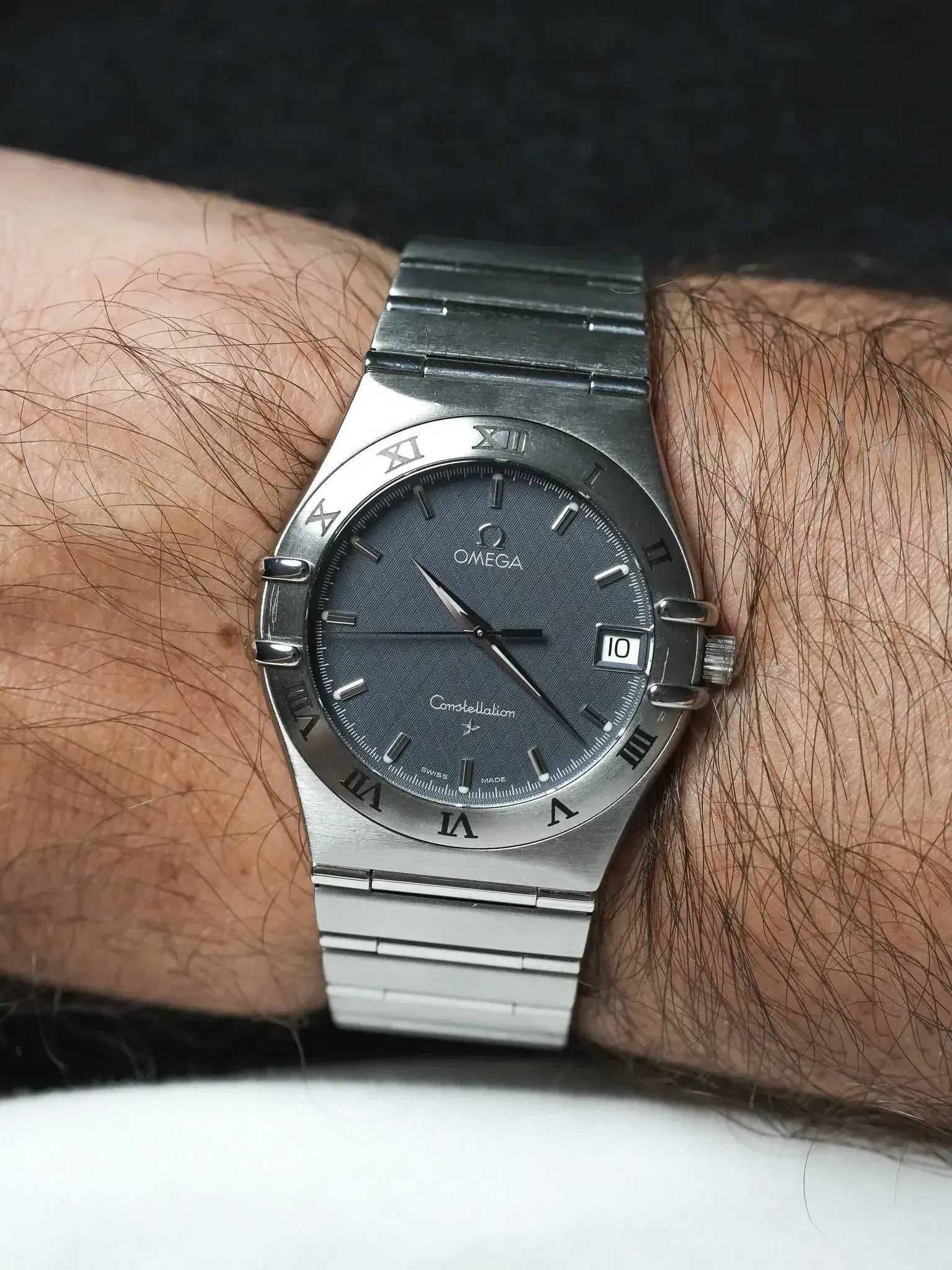
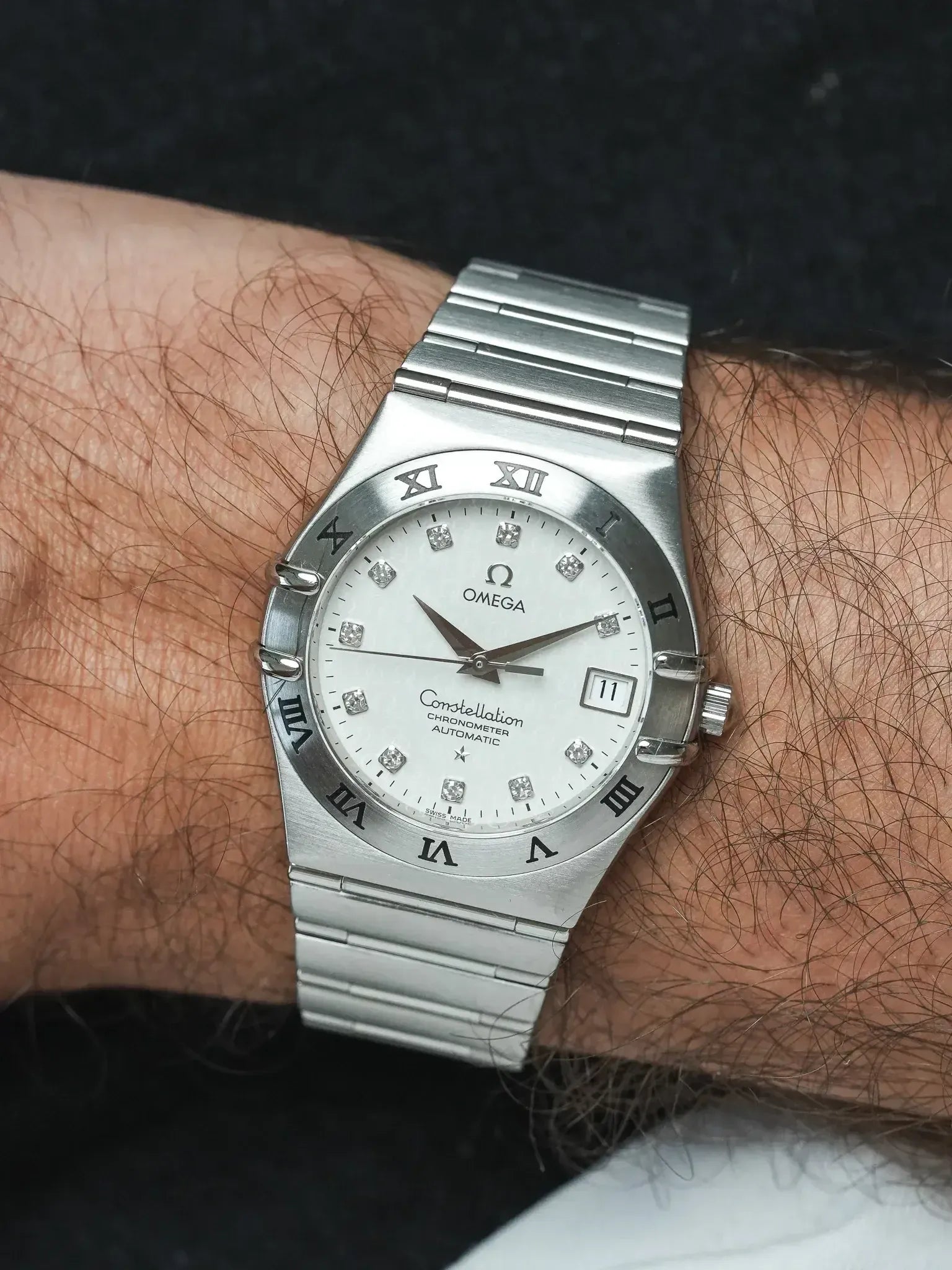
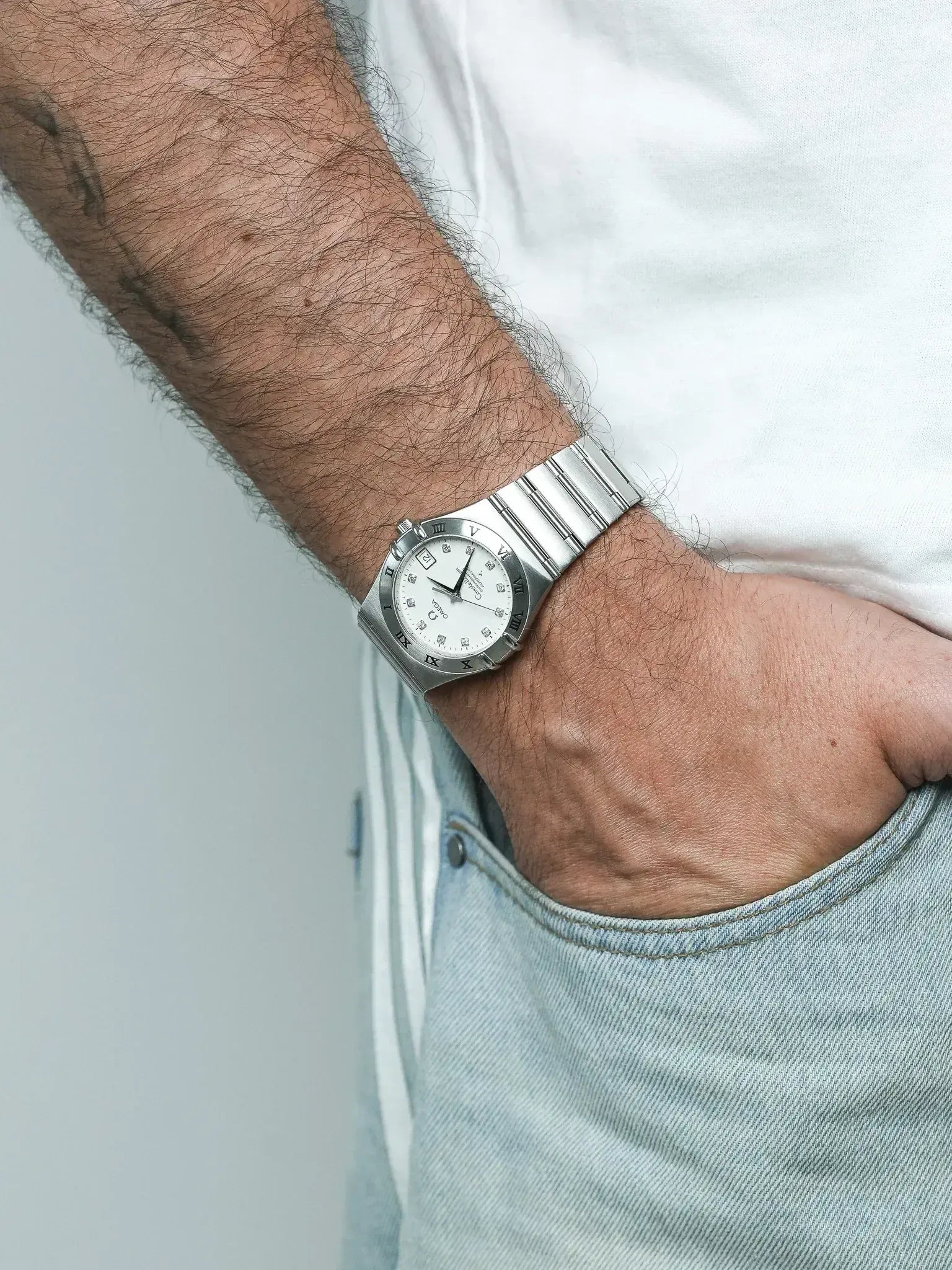
The most emblematic vintage variation is the Constellation "Pie Pan", so named for its faceted dial reminiscent of an upside-down pie tin. Pie Pan models from the 1950s-60s are powered by the 354 calibres (with stop, known as "bumper"), then 501/505 and 551/561 (full rotor). Later, the Constellation C-Shape of the 1970s introduced an integrated case, while the Constellation Manhattan (1980s) established the four "claws" on the bezel, defining the line's contemporary aesthetic.
De Ville: The Dress Profile
The Omega De Ville brings together the manufacture's evening watches. Initially appearing in the 1960s as a sub-collection (bearing the double designation "Seamaster De Ville"), it became independent in 1967. These watches are characterized by extra-thin cases, minimalist dials, and slim straps. They are often fitted with calibres 620 (manual) and 1002 (automatic). In 18-carat gold or gold-plated, they offer a highly accomplished classic alternative.
Genève: Access to the Manufacture
Produced from the 1960s to the 1980s, the Omega Genève is often the gateway into the brand's vintage universe. It uses the same high-quality calibres as the Seamaster (552, 565, 1012) while exploring more diversified case designs. The Dynamic sub-collection (oval format) and the Chronostop model (single-pusher chronograph) are particularly sought-after variations.
Omega Calibres: Understanding Vintage Movements
The manufacture's period calibres are renowned for their architecture:
- Calibre 30 / 30T2 — hand-wound (1940s-60s). The post-war mechanical foundation, renowned for its robustness.
- Calibre 321 — hand-wound chronograph (column wheel). The engine of the first Speedmaster. It is the calibre most prized by collectors.
- Calibres 351/354 "Bumper" — the brand's first automatic movements. The rotor oscillates over approximately 120° as it strikes against springs, offering a unique tactile feel on the wrist.
- Calibres 501 to 565 — full-rotor automatic movements (1950s-60s), standards of the golden age of the Seamaster and Constellation.
- Calibre 861/1861 — cam-switched chronograph replacing the 321 from 1968 onward in the Speedmaster. Reliable and optimised for production.
- Calibres 1010 to 1022 — automatic movements from the 1970s, slimmer but with a slightly more complex architecture.
Within the Atelier Victor, our watchmakers service all of these mechanisms: disassembly, cleaning, lubrication, and chronometric adjustment.
Omega vs Rolex: Historical Positioning
During the 1950s and 1960s, Omega and Rolex operated in the same price and quality segment. Omega calibres from this period (5xx series) offer engineering and finishing (Côtes de Genève, perlage) entirely comparable to, and sometimes even superior to, Rolex standards of the time. The current valuation gap on the pre-owned market mainly stems from the positioning strategies adopted from the 1980s onward. Today, a Seamaster from the 1960s represents an opportunity to acquire a high-grade mechanical movement at a very competitive price.
How to Recognise an Authentic Piece
Here are the authentication points checked by our experts:
- The Logo (Ω) — its typographic evolution helps date the dial precisely.
- The Serial Number — engraved on the movement or the case, it makes it possible to trace the year of production.
- The Caseback Medallions — the Observatory (Constellation) or the Hippocampus (Seamaster).
- The Calibre — the movement architecture must be consistent with the case reference.
- The Dial and Hands — the consistency of the luminous patina (radium or tritium) is scrupulously analysed.
Each piece sold by Atelier Victor is delivered with an invoice serving as a lifetime certificate of authenticity.
The Pre-Owned Market
Observers regularly consider Omega to be one of the manufactures offering the best value for money in vintage watchmaking. Highly sought-after models include the Speedmaster pre-moon (calibre 321), the Constellation Pie Pan, and the historic Seamaster 300. Obtaining an Omega Extract from the Archives is a real advantage when enhancing the watch’s value.
Frequently Asked Questions — Classic Omega Watches
Which model should you choose for a first purchase?
The Genève is the ideal entry point: manufacture calibres (552, 1012) and accessible pre-owned prices. The Seamaster automatic adds an extra historical dimension. For chronographs, the Speedmaster Professional remains the reference.
What is a "Pie Pan" dial?
It is the twelve-faceted dial characteristic of the Constellation from the 1950s and 1960s. Its sloping edge recalls the shape of an inverted pie tin. It is one of the brand’s most iconic designs.
What do the 8 stars on the Constellation represent?
They symbolize the eight chronometric precision records won by the brand between 1933 and 1952 during the Swiss observatory competitions.
Calibre 321 or 861: what is the difference?
The 321 is the original column-wheel chronograph (1957-1968), complex and highly sought-after. The 861 replaced it with a cam system, optimizing production while retaining excellent reliability.
What is a "bumper" movement?
It is an early automatic movement in which the rotor oscillates over a restricted arc (around 120 degrees), striking buffer springs and creating a perceptible vibration on the wrist.
Is an old Seamaster water-resistant?
It is strongly discouraged to immerse a period watch, as the water-resistance gaskets no longer meet factory standards. de ville use (protection against rain and splashes) is, however, perfectly suitable.
Can the watch’s history be obtained?
Yes. The manufacture offers an Extract from the Archives service that certifies the exact year of production and the original country of delivery thanks to the serial number.
Which models should be favored for a feminine wrist?
The De Ville ultra-thin, the Constellation small in size, and the Genève are a perfect fit. Discover them in our women's selection.
Where can I get a suitable strap?
We provide a wide range of compatible straps (18 mm, 19 mm, 20 mm). Contact us via WhatsApp for any technical advice.
Explore the manufacture's models: Speedmaster, Seamaster, Constellation, De Ville.
Need advice or have a hesitation? Our experts are here to assist you.